

Analysis Of Theme & Genre

Genres:
Rougelike, Construction & Management Simulation, Whimsical-Horror
Cults, Religions, Mythology, Animals
Themes:
Cult of the Lamb
A Roguelike developed by Massive Monster & published by Devolver Digital.
The game follows a lamb who is saved from death by a god named the One Who Waits, to repay their debt they must create a loyal cult in the former's name, as the vessel of the Red Crown.

The two most significant themes of Cult of the Lamb are cults and religion. Presented through whimsical horror, you exploit your followers for your own gain. Although these themes are explored throughout the narrative, the majority of the storytelling is delivered through the music and visuals. For example, in many legends, religions, and myths, there is the visage of the sacrificial lamb, which Cult of the Lamb uses both to reference existing mythos and to contrast the dark nature of the game by presenting a cute lamb mascot.
Personally, I think the game does a decent job of exploring its core themes, but I also believe it could do a better job. As I wrote in my previous paragraph, almost the entire story is conveyed through visuals and music. While the game does not suffer from a lack of exposition, I feel it would benefit from delving deeper into its world, rather than merely wading in a pool that has far greater depth than we are currently exposed to.
(SIMILAR GAME)
The Binding of Isaac
Like Cult of the Lamb, The Binding of Isaac communicates its themes largely through visuals and symbolism rather than direct narrative. However, where Cult of the Lamb uses contrast between cute imagery and dark, The Binding of Isaac removes leans into discomfort and grotesque. As a result, The Binding of Isaac feels more focused and deliberate in how it explores religion and suffering, whereas Cult of the Lamb occasionally softens its themes through humour and charm.


Peak
Action-Adventure, Cooperative, Climbing, Survival, Friendslop
Mountain Climbing, Friendship, Survival
Genres:
Themes:
Developed and published by Aggro Crab and Landfall.
The player's objective in the game is to climb a pre-generated mountain with up to four players. Various items that can be found along the way which may assist in the ascent
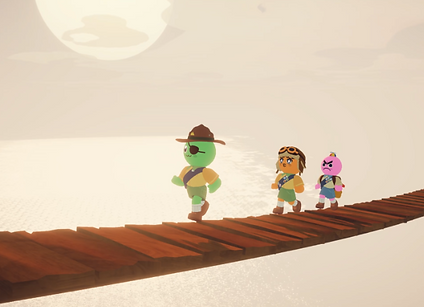
PEAK, a game where you and your friends must climb mountains together. Like many games within the Friendslop genre social interactivity is the binding glue of PEAK. Giving each other helping hands up a climb or throwing a frisbee into your friend resulting in their accidental death. PEAK explores survival, the struggle and how working with your friends can help you overcome great obstacles.
When it comes to any cooperative game, no matter the quality I’ll have to answer that it depends. I can't concretely say it does communicate its themes good or bad. Simply because, the friends you play it with, if you and your friends fully engage with the game absolutely it does an excellent job of communicating its theme. If you and your friends mess around trying to kill each other the question is probably not relevant to you.
PEAK already communicates its themes effectively through its cooperative mechanics and player interaction, meaning little improvement is necessary. Shared success and failure naturally reinforces its focus on survival, struggle, and teamwork.
(SIMILAR GAME)
Keep talking and nobody explodes
Like PEAK, Keep Talking and Nobody Explodes is built around cooperation, with its themes only fully emerging when players take the game seriously. In Keep Talking and Nobody Explodes, success depends entirely on communication between players, meaning failure is often the result of poor coordination rather than mechanical difficulty. Similarly to PEAK, the game’s themes are not forced onto the player; instead, they naturally arise from how the players choose to engage, making the experience dependent on group dynamics.

The Dark Queen of Mortholme
Genres:
Macabre-Atmospheric, Psychological, Second Person Narrative, Pixel Art, Anti-Game
Inevitability, Failure, Power
Themes:
Developed by Mosu & published by Monster Theatre.
A macabre, short-form, second-person indie, you play as The Dark Queen of Mortholme, the boss battling the Hero.

This game is quite atypical. It places you in the position of the boss: you are the boss battle. It is an anti-game; it does not want you to win. With every victory, the hero reappears to kill you again. No matter how much you succeed, the hero will return until the game grinds you down, leading to inevitable defeat. It is a game that presents acceptance of failure and the reality of being powerless against what you cannot change.
Honestly, out of the games I listed, I think this one does the best job of showcasing its themes. This may be because it is the shortest of the group, giving it less time to undermine itself; however, during its brief playtime, the game evokes strong feelings of your inevitable approach towards death, which is portrayed as unavoidable. Increasing the game's length might be the only way I can see the game enhancing its theme communication.
(SIMILAR GAME)
Might Jill off
Like The Dark Queen of Mortholme, Mighty Jill Off refuses the traditional idea of progression and triumph by making failure and repetition a part of its core. In Dark Queen, the hero keeps returning no matter how many times you defeat them, emphasising inevitability, whereas in Mighty Jill Off the protagonist constantly climbs up to the Queen and gets kicked back down, reinforcing the futility of the effort and the acceptance of repeated defeat. Both games use minimal gameplay loops not to frustrate for its own sake, but to communicate that the journey of the struggle against forces you cannot truly overcome.


Popular Game Analysis
Minecraft
Crafting System
Minecraft has a simple to understand crafting system which acts as the main avenue for player progression. Interacting with the crafting system, can yield blocks and upgrade gear, which helps in defeating mobs, along with increasing gathering speed to hasten progression further.
“Players craft by arranging items in the crafting grid to match a given recipe. Small crafting recipes that are at most 2×2 can be made there, including wooden planks, sticks, crafting tables, and torches.” (Minecraft Wiki, 2025)
The Crafting Table is almost always the first thing a player will craft. “To craft more complex items, a crafting table must be created, placed, and used. This brings up an interface with a larger 3×3 crafting grid in which the player can use to craft any crafting recipe in the game. Recipes fitting the 2×2 grid can also be crafted in the crafting table's 3×3 grid. There is a recipe book button in the inventory where the player can access all of their unlocked crafting recipes.” (Minecraft Wiki, 2025)
One’s ability to craft is entirely dependent on the resources they have accumulated.
Crafting is an essential mechanic within Minecraft being in the name for one thing, but most of all it adds value to the time spent collecting resources and value to the resources themselves. The progression aspect of crafting gives people a reason to engage with the resource collection in the game.
Strengths of the system relating to a 12 - 16 year olds experience of gaming would in my opinion be the work needed to acquire certain items. If you want Diamonds you have to put in the time to find them, this makes the process take effort and you’re rewarded for this by unlocking crafting recipes for useful items.
A weakness I see in the crafting system is I don’t think it’s as rewarding to players who have played through the game before.
Day & Night Cycle
Day & Night is how Minecraft communicates safety and danger to its players. During the day the game is safe, excluding the Warden, other dimensions and fall damage. Night is the opposite as it’s when mobs (skeletons, zombies and creepers) begin spawning these creatures early on in the game especially can overwhelm and kill the player if caught unprepared.
“When a player first spawns in singleplayer, the daylight cycle always starts at the beginning of the daytime (0:00). Most multiplayer servers also start at the beginning of the daytime, but the daylight cycle continues regardless of any new players joining.” (Minecraft Wiki, 2025)
The game upon starting is daytime to give to the player a bit of a grace period before they are under attack.
“During the nighttime, the world is covered in darkness; the internal sky light level falls to a minimum of 4, which allows hostile mobs to spawn on the surface.” (Minecraft Wiki, 2025)
Players can place torches and other sources of light to prevent the spawning of dangerous mobs.
Strengths of a Day and Night cycle are clear; it puts pressure on the player to do things. If for example it was daytime all of the time the player would be lax and not too bothered about completing anything too quickly as lack of pressure caused because constant safety will disengage the player.
Weaknesses in the Day and Night cycle are the threats the player faces at night, if they aren’t challenging enough to combat nighttime just becomes an annoyance more than something which encourages players to engage in the game.
Art Style
Minecraft’s aesthetic is a blocky, voxel, simplistic look. As a pixel artist I see it as pretty much a 3D pixel art.
As a pixel artist I feel I can explain the appeal of Minecraft’s style. One is with everything being not overly complicated even someone not particularly artistically inclined can produce a satisfactory build to their liking.
I think another reason it works is everything important stands out a lot more when things are kept simple, a shiny diamond for example.
Learning
Minecraft includes countless ways in which it teaches the player something useful. It even has a special Minecraft Education Mode with a focus on learning. The ability to learn from Minecraft is so much that schools have utilised its learning potential.
Bartle’s Player Types
Personally I think Minecraft appeals to Killers due to the mob and boss fighting involved. It appeals to Socialisers, the game has a strong online multiplayer presence within gaming. Finally it’s a game Explorers enjoy as there is plenty to find in Minecraft through venturing across the world.
Roblox
Social Interaction Systems
Playing Roblox can be a solo experience but often for many players there is a strong multiplayer scene.
The game features a chat box which any player can message and talk to other players. I wouldn’t say it adds much to the experience unless you’re a sociable person.
Additionally it’s not the best for learning and would be highly dependent on your interactions with other players and ones where you learn would be rare.
Roblox’s social system has enormous flaws as well and calls into question child safety in video games, as many unsavoury people use it to reach out to vulnerable persons to exploit them.
User Generated Games
One of Roblox’s biggest selling points is that it has a vast library of games to play all created by the Users.
The strength of this is that they have a wide range of games to select from that appeal to many different audiences of people and cater to many different playstyles.
Again though it prompts talks around child safety issues, Roblox does not do a good job of moderation and making sure inappropriate games aren’t published and are removed. Furthermore I believe personally the varied selection of games harms player attention span leaving players bouncing between many games without settling on one.
Learning wise a player could learn quite a bit or very little it would depend on the User Generated Games they find and choose to play.
Bartle’s Player Types
Roblox appeals to all player types without doubt, simply due to the User Generated Content, every single type of game can be found on its platform meaning it targets every type of player.
Role Research: Game Designer
A game designer is responsible for turning creative ideas into an interactive and enjoyable experience. Essentially “turning a series of ideas and artwork into a fun game,” (GameDesignSkills, 2025) distinguishing designers from artists and programmers who create assets but do not determine “where that art is placed” or “what actions from the player cause that to happen” (GameDesignSkills, 2025).
Description of the Role
The primary role of a game designer is to conceptualise and structure gameplay systems. They determine player progression, mechanics, difficulty balancing, and how narrative elements integrate with gameplay.
Day-to-Day Tasks
On a daily basis, game designers write and revise design documents, prototype mechanics, conduct playtesting sessions, and adjust systems based on feedback. Designers must have “familiarity with game systems,” which involves both creating and playing games “with an eye to what makes them work” (GameVoyages, 2025). Analysing other games allows designers to understand mechanics, pacing, and engagement strategies. Additionally, designers “keep up with gaming trends” to ensure their work remains relevant within a competitive industry (GameVoyages, 2025). Collaboration with programmers and artists is also a consistent responsibility, ensuring that mechanics are implemented as intended.
Responsibilities & Expectations
A key expectation of a game designer is empathy. As noted, “Empathy is crucial. You need to get inside the player’s head” and understand their “motivations, frustrations, and desires” (GameVoyages, 2025). Ultimately, they are responsible for ensuring that gameplay is coherent, engaging, and enjoyable.
References
GameDesignSkills, n.d. Video Game Designer: Definition, Skills, Facts, Responsibilities. Available at: https://gamedesignskills.com/game-design/game-designer/ [Accessed 20 Feb. 2026].
GameVoyages, 2025. What makes a good game designer? Available at: https://gamevoyages.com/what-makes-a-good-game-designer/ [Accessed 20 Feb. 2026].
Technique Research Report: Storyboarding
Introduction
Storyboarding is a visual planning technique used to map out narrative progression, key events, and player interactions before development begins.
Description of the Technique
A storyboard is typically created through a rough sketching process that visually represents key scenes. According to Interactivity Hub (n.d.), creating a rough storyboard involves several practical steps:
-
Get the Basic Layout – Begin by drawing a simple layout of important scenes and settings. The aim is not artistic perfection, but to communicate the main idea of each moment clearly. This helps identify essential environments and narrative beats early in development (Interactivity Hub, n.d.).
-
Use Simple Shapes and Stick Figures – Detailed artwork is unnecessary at this stage. Simple geometric shapes and stick figures can effectively represent characters, objects, and environments. This keeps the focus on structure rather than visual polish (Interactivity Hub, n.d.).
-
Show the Actions – Arrows or lines should be used to demonstrate movement and interaction within each scene. This helps visualise how characters act, how events unfold, and how the narrative progresses from one moment to another (Interactivity Hub, n.d.).
By keeping the sketches simple, developers can concentrate on storytelling, pacing, and scene sequencing rather than graphical detail.
Purpose and Benefits
Storyboarding clarifies narrative structure. It allows developers to identify missing scenes, unnecessary content, or weak transitions before implementation begins. For solo developers like myself, it also reduces strain by externalising ideas into a structured visual format.
My Project
In a solo narrative game project, storyboarding would allow the entire story arc to be visualised before implementation in Construct 3. This approach could prevent rushed narrative construction. Planning visually ensures that character actions, player choices, and story progression is right before time is invested.
Conclusion
Storyboarding is a practical and accessible planning technique for narrative-focused games. Through rough sketches, simple shapes, and action indicators, developers can structure their story effectively before development begins.
Reference
Interactivity Hub, n.d. How to create a rough sketch for storyboarding. Available at: https://interactivityhub.com [Accessed 20 February 2026].
Audience
The Teen Player
Name & Demographics
(Alex) & (Jordan)
Ages – 12 to 16
Location – England
Bio – At this stage, teenagers are developing stronger critical thinking skills and personal values. They are beginning to question systems, authority, and long-term consequences. They are highly socially influenced, increasingly independent, and more aware of global issues such as sustainability.
Personality – Curious, Socially Aware, Opinionated, Experimental, Developing Identity
Gaming Habits
Most Teen players have broad exposure to games across multiple genres. Some are familiar with narrative-driven games, multiplayer titles, sandbox environments, and mobile games. They expect interactivity, meaningful choice, and progression systems. If a game is educational, they prefer learning to feel embedded within gameplay rather than delivered as direct instruction.
Most are comfortable with reading brief dialogue, and understanding consequences within branching narratives. However, attention spans may fluctuate if pacing is slow or overly text-heavy.
Platforms
Primarily:
-
Console (PlayStation, Xbox, Nintendo Switch)
-
PC / Laptop
-
Mobile (secondary platform)
Unlike younger children, teens are comfortable with controllers, keyboard and mouse, and more complex UI systems. They expect responsive controls and clear feedback.
Goals
-
Meaningful choice and consequence
-
Narrative depth with relatable characters
-
Exploration of real-world issues without being preachy
-
Progression and achievement systems
-
Freedom to experiment and see outcomes
-
Subtle educational value embedded within gameplay
Hates
-
Heavy exposition without interaction
-
Forced moral messaging
-
Repetitive tasks
-
Poor pacing
Favourite Game Types
-
Narrative adventure games
-
Choice-based stories
-
Simulation or management games
-
Sandbox games with creative systems
-
Strategy games with consequence-based outcomes
The Parent / Guardian
Ages – 30 to 50
Location – England
Motto – “Is this beneficial as well as entertaining?”
Bio
Parents of teenagers are concerned with content appropriateness, educational value, and screen time balance. They are less restrictive than with younger children but remain attentive to themes, language, and monetisation systems. They may value sustainability, particularly if framed as educational.
Personality - Protective, Pragmatic, Value-Driven, Time-Conscious
Gaming Habits
Parents vary widely. Some are familiar with gaming and understand genre differences; others rely on ratings and reviews. They are more comfortable allowing narrative games than highly graphic or online competitive titles. Educational framing increases trust.
Goals
-
Age-appropriate themes
-
Educational or developmental benefit
-
Positive messaging
-
No aggressive monetisation
-
Safe content (minimal graphic violence, no gambling mechanics)
Hates
-
Excessive violence
-
Inappropriate language
-
Hidden microtransactions
-
Overt political messaging
-
Addictive design patterns